70th anniversary of CERN in Spain

70th anniversary of CERN in Spain

Organized by the Ministry of Science, Innovation and Universities, the Consejo Superior de Investigaciones Científicas (CSIC), the Centro de Investigaciones Energéticas, Medioambientales y Tecnológicas (CIEMAT), the Centro Nacional de Física de Fículas, Astropartículas y Nuclear (CPAN), the Agencia Estatal de Investigación (AEI), the Centro para el Desarrollo Tecnológico e Innovación (CDTI) and the Fundación Española para la Ciencia y la Tecnología (FECYT), this event commemorates the 70th anniversary of CERN in Spain. It will take place before the official celebration ceremony, scheduled for October 1st at CERN.

AGENDA

09:00 – Welcome

09:45 – Opening speech
CERN Directorate (TBC)

10:30 – Video: History of CERN: Celebrating 70 years.
A journey through the history, present and future of Spain’s participation in CERN.

11:00 – Coffee break

11:30 – Unveiling the fundamental laws of nature at CERN: past, present and future.
Round table and debate

12:30 – Spain’s role in CERN’s technological developments and their impact on society
Round table and debate

13:30 – Closing
General Secretariat for Research, MICIU
ESSRI, Energy for Sustainable Science at Research Infrastructures

ESSRI, Energy for Sustainable Science at Research Infrastructures

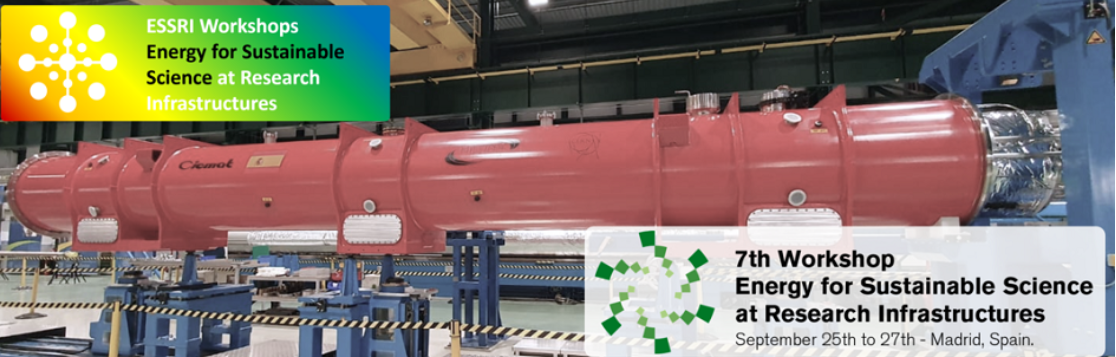
CIEMAT, in collaboration with CERN, ESRF, DESY, PSI, ESS and ERF, will organize the Seventh Workshop on Energy for Sustainable Science in Research Infrastructures in Madrid on September 25-27, 2024. This event follows the tradition of previous workshops organized by ESS (2011), CERN (2013), DESY (2015), ELI-NP (2017), PSI (2019) and ESRF (2022).
The objective of the workshop is to identify technical and strategic challenges to develop and implement sustainable solutions in research infrastructures. Topics such as energy management, exchange of experiences on energy efficient technologies, sustainability in current research projects and life cycle analysis of these infrastructures will be addressed. In addition, the participation of PhD students will be encouraged in order to involve young researchers in these key issues for the future of sustainable science.

Those interested can register at the following link:

Light-Matter Interaction at Nanoscale

Light-Matter Interaction at Nanoscale

IQF Blas Cabrera, CSIC Serrano, Madrid 23rd – 25th September 2024

Join us in Madrid for the second edition of the biennial LMI meeting, aiming to discuss recent progress and future perspectives on the captivating world of experimental and theoretical photophysics and photochemistry of low-dimensional structures. We are looking forward to bring together experts on light-matter interactions at the nanoscale investigated by scanning probe microscopies (SPM). This encompasses from the latest technical developments on advanced tip enhanced spectromicroscopies (TERS, Electro and Photoluminescence) to ultrafast (pulsed sources, THz-STM) phenomena in quantum dots or single molecules within plasmonic nanocavities. This convergence promises a stimulating environment for students, postdocs and world-renowned scientists to collectively explore the frontiers of the field!

IUVSTA-ZCAM METAL-OXIDE ULTRATHIN FILMS AND NANOSTRUCTURES: EXPERIMENT MEETS THEORY

IUVSTA-ZCAM METAL-OXIDE ULTRATHIN FILMS AND NANOSTRUCTURES: EXPERIMENT MEETS THEORY

IUVSTA-ZCAM METAL-OXIDE ULTRATHIN FILMS AND NANOSTRUCTURES: EXPERIMENT MEETS THEORY


DATE OF EVENT : 03/07/2023      DURATION : 5 day(s)

LOCATION: ZCAM Campus Actur C/ Mariano Esquillor s/n Edificio I+D 50018 Zaragoza

A new energy economy is needed which has to be more efficient, clean and sustainable. Functional oxide-based energy materials hold the greatest promise for both, energy storage and conversion. Metal oxides are stable and abundant materials to be used for energy applications. Metal-oxide ultrathin films and nanostructures are most versatile in terms of electronic structure, chemical, and physical properties but deriving structure-property-function relationships for these often structurally and chemically very dynamic materials is challenging. Nanostructured oxides offer a new paradigm for the development of catalytic, photochemical, electrochemical and electronic materials. This meeting will focus on four different areas where understanding, controlling and enhancing the functionalities of oxides for energy solutions play a crucial role, namely, oxides in catalytic and electrochemical energy science as well as in photochemical energy transformation and the design of nanostructured oxide-based materials. This needs in-depth scientific debate from leaders across the community.

Verónica Ganduglia-Pirovano, Premio RAICES y LELOIR 2022

Verónica Ganduglia-Pirovano, Premio RAICES y LELOIR 2022

Los Premios RAICES están destinados a científicos/as, investigadores/as y tecnólogos/as argentinos/as que residen en el exterior y colaboran activamente con el fortalecimiento del Sistema Nacional de Ciencia, Tecnología e Innovación. Por su parte, los Premios LELOIR están destinados a científicos/as, investigadores/as y tecnólogos/as extranjeras/os que han trabajado en el fortalecimiento de las capacidades científicas y tecnológicas de Argentina. Ambos galardones buscan reconocer y visibilizar las contribuciones con el sistema nacional de ciencia y estrechar lazos de cooperación internacional.

Para estos Premios, en la edición de 2022, se recibieron un total de 74 nominaciones, correspondientes a 58 científicos y a 16 científicas. De estas candidaturas, 22 fueron postulados/as para los Premios LELOIR, y 52 para los Premios RAICES. En cuanto a los países de residencia de los/as científicos/as   nominados/as ellos residen en: Alemania, Australia, Brasil, Canadá, Chile, España, Estados Unidos, Finlandia, Francia, Israel, Italia, México, Reino Unido y Sudáfrica.

En el Área 3, Ciencias Exactas y Naturales, la galardonada en la edición del año 2022 del Premio RAICES, ha sido la Dra. M. Verónica Ganduglia-Pirovano, del Instituto de Catálisis y Petroleoquímica del Consejo Superior de Investigaciones Científicas, en Madrid (España), en reconocimiento de “su importante trabajo para el fortalecimiento de las redes de científicos/as argentinos/as en el exterior

La Dra. María Verónica Ganduglia-Pirovano actualmente desarrolla su trabajo en el Instituto de Catálisis y Petroleoquímica del Consejo Superior de Investigaciones Científicas (CSIC) en Madrid. Es Licenciada en Física por el Instituto Balseiro (San Carlos de Bariloche, Argentina) y Doctora en Ciencias, desde 1989, por el Instituto Max-Planck y la Universidad de Stuttgart (Alemania). Ha colaborado en redes del Programa RAICES, promocionando la participación y formación de investigadores argentinos. Ha realizado numerosas estancias en universidades e institutos de investigación argentinos, muchas de ellas financiadas por el Programa Raíces-Subsidio César Milstein, y ha mantenido colaboraciones con investigadores que desarrollan sus tareas en instituciones públicas argentinas (Buenos Aires, La Plata, Bahía Blanca, Santa Fe o Rosario). Recibió y dirigió en el Instituto de Catálisis y Petroleoquímica (CSIC, Madrid, España) a dos becarios postdoctorales argentinos con los que mantiene una colaboración activa. Ha participado como conferencista invitada, exponiendo sus trabajos o como organizadora, en seminarios, workshops, reuniones y encuentros.