70th anniversary of CERN in Spain

70th anniversary of CERN in Spain

Organized by the Ministry of Science, Innovation and Universities, the Consejo Superior de Investigaciones Científicas (CSIC), the Centro de Investigaciones Energéticas, Medioambientales y Tecnológicas (CIEMAT), the Centro Nacional de Física de Fículas, Astropartículas y Nuclear (CPAN), the Agencia Estatal de Investigación (AEI), the Centro para el Desarrollo Tecnológico e Innovación (CDTI) and the Fundación Española para la Ciencia y la Tecnología (FECYT), this event commemorates the 70th anniversary of CERN in Spain. It will take place before the official celebration ceremony, scheduled for October 1st at CERN.

AGENDA

09:00 – Welcome

09:45 – Opening speech
CERN Directorate (TBC)

10:30 – Video: History of CERN: Celebrating 70 years.
A journey through the history, present and future of Spain’s participation in CERN.

11:00 – Coffee break

11:30 – Unveiling the fundamental laws of nature at CERN: past, present and future.
Round table and debate

12:30 – Spain’s role in CERN’s technological developments and their impact on society
Round table and debate

13:30 – Closing
General Secretariat for Research, MICIU
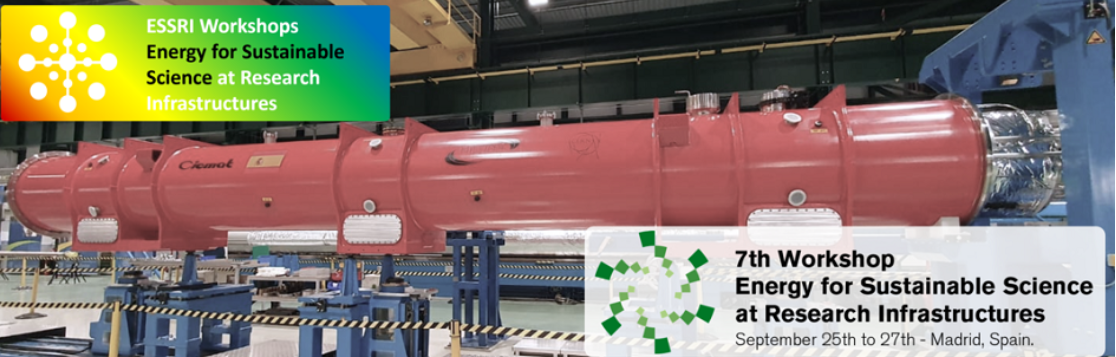
ESSRI, Energy for Sustainable Science at Research Infrastructures

ESSRI, Energy for Sustainable Science at Research Infrastructures

CIEMAT, in collaboration with CERN, ESRF, DESY, PSI, ESS and ERF, will organize the Seventh Workshop on Energy for Sustainable Science in Research Infrastructures in Madrid on September 25-27, 2024. This event follows the tradition of previous workshops organized by ESS (2011), CERN (2013), DESY (2015), ELI-NP (2017), PSI (2019) and ESRF (2022).
The objective of the workshop is to identify technical and strategic challenges to develop and implement sustainable solutions in research infrastructures. Topics such as energy management, exchange of experiences on energy efficient technologies, sustainability in current research projects and life cycle analysis of these infrastructures will be addressed. In addition, the participation of PhD students will be encouraged in order to involve young researchers in these key issues for the future of sustainable science.

Those interested can register at the following link:

Light-Matter Interaction at Nanoscale

Light-Matter Interaction at Nanoscale

IQF Blas Cabrera, CSIC Serrano, Madrid 23rd – 25th September 2024

Join us in Madrid for the second edition of the biennial LMI meeting, aiming to discuss recent progress and future perspectives on the captivating world of experimental and theoretical photophysics and photochemistry of low-dimensional structures. We are looking forward to bring together experts on light-matter interactions at the nanoscale investigated by scanning probe microscopies (SPM). This encompasses from the latest technical developments on advanced tip enhanced spectromicroscopies (TERS, Electro and Photoluminescence) to ultrafast (pulsed sources, THz-STM) phenomena in quantum dots or single molecules within plasmonic nanocavities. This convergence promises a stimulating environment for students, postdocs and world-renowned scientists to collectively explore the frontiers of the field!

Survival of an Antarctic cyanobacterial mat under Martian conditions

Survival of an Antarctic cyanobacterial mat under Martian conditions

Author: Martin-Andres, I., Sobrado, J. , Cavalcante, E. ; Quesada, A; 

Front. Microbiol. Volume 15 – 2024 | https://doi.org/10.3389/fmicb.2024.1350457

Abstract:
Antarctica is one of the most outstanding analogs of Mars, and cyanobacterial mats are considered one of the most resilient biological consortia. The purpose of this study is to find out the effect of the Martian conditions on an Antarctic cyanobacterial mat. We exposed an Antarctic microbial mat to Martian conditions in a simulating chamber (MARTE) for 15 d and investigated the variations in the consortium by the use of 16S rRNA gene expression as an indicator of the biological activity. Metabarcoding using the V3-V4 regions of the 16S rRNA gene was used to determine the succession of the active members of the microbial consortium during the experiment. The results showed that the microbial mat, far from collapsing, can survive the stringent conditions in the simulating chamber. Different behaviors were displayed depending on the metabolic capabilities and physiological characteristics of every taxon. The main conclusion is that the Martian conditions did not impair growth in some of the groups, and thus, the investigated Antarctic community would be able to survive in a Martian environment at least during the short experimental period, although elements of the community were affected in different ways.